
Industrial IoT Software for Downstream Operations

Industrial Internet of Things (IoT) software connects field devices, sensors, equipment, and operational applications. In downstream operations, it helps organize information from refinery equipment, storage facilities, pipeline infrastructure, and product distribution activities so that operational teams can access relevant measurements and events.

Discuss Your Requirements

Connecting Industrial Devices with Operational Systems

Refinex focuses on the software architecture needed to collect device information, associate observations with the correct assets, manage operational records, and make structured data available to enterprise applications and AI-supported decision functions.

Downstream facilities depend on information from distributed equipment and instrumentation. Pumps, compressors, storage tanks, flow meters, pressure transmitters, temperature sensors, and other connected devices can produce information that must be collected and interpreted within its operating context.

An industrial IoT software layer provides a structured path between these field observations and the applications that use them.

Connecting Industrial Devices with Operational Systems

01

Device connectivity: Receiving information from connected sensors, gateways, meters, and industrial devices through validated interfaces.

02

Data ingestion: Collecting measurements, status changes, equipment events, and device messages.

03

Asset association: Connecting incoming information with the correct equipment identifier, facility, process area, and operating context.

04

Event processing: Organizing incoming records, identifying duplicates, and managing delayed or incomplete messages.

05

Operational visibility: Making relevant measurements and events available through dashboards, notifications, and authorized applications.

06

Enterprise data exchange: Providing structured information to approved business and operational systems.

The software architecture should reflect the actual equipment, communication environment, data requirements, and operational responsibilities of each facility.

From Field Devices to Operational Information

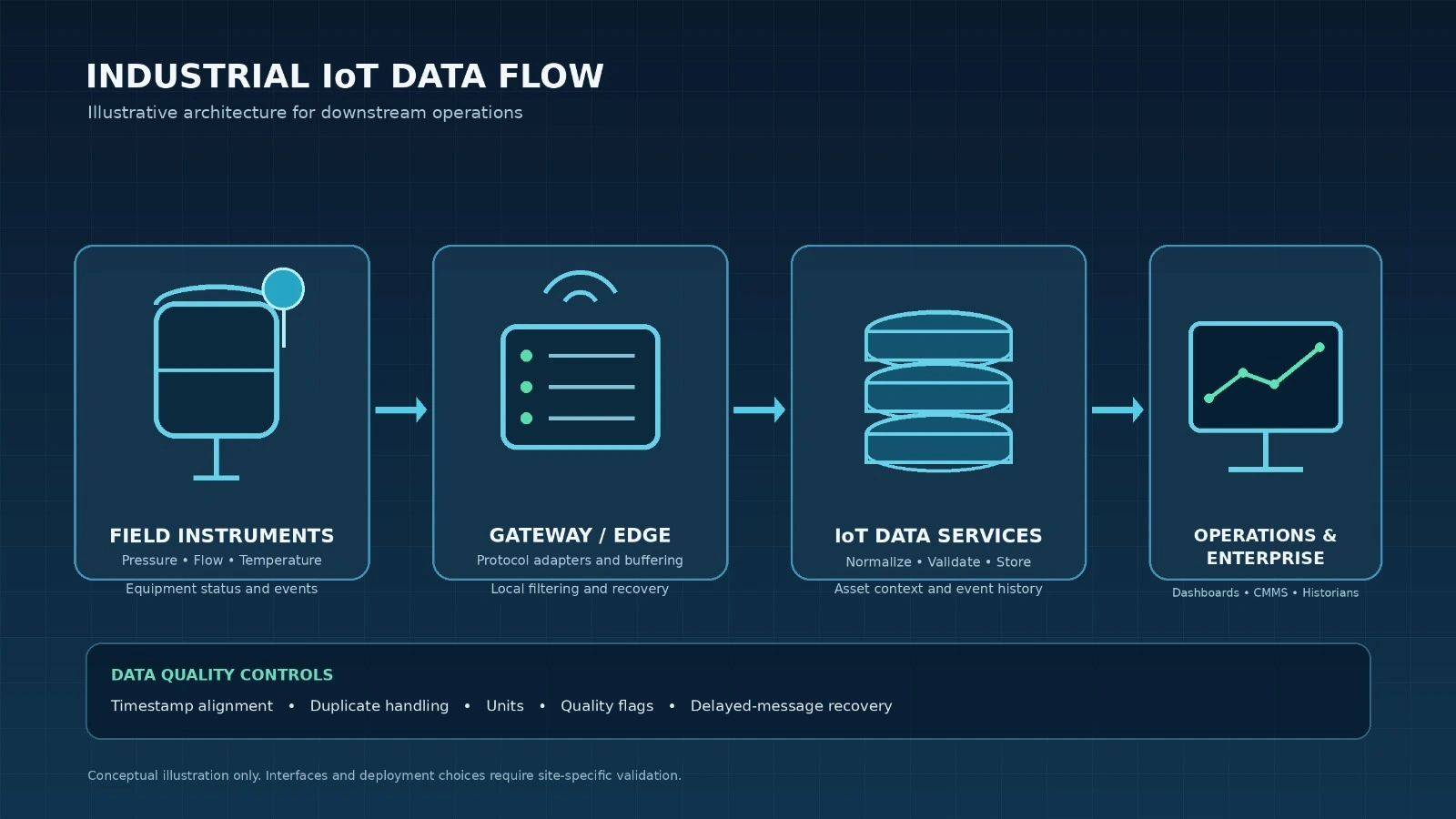
An IoT software workflow begins with physical observations and continues through data processing, contextual association, storage, and delivery to operational users.

01

Device and Sensor Data Ingestion

02

Data Normalization

03

Asset Association

04

Data Storage and Event Processing

05

Operational Applications

Device and Sensor Data Ingestion

Connected field devices generate information such as equipment status, pressure readings, temperature measurements, flow rates, vibration observations, and communication health indicators.

IoT ingestion services receive these records through configured device adapters, gateways, or approved interfaces. Incoming data should retain its original timestamp and source information wherever available.

The ingestion layer should also account for different device reporting intervals, missing or delayed messages, inconsistent timestamp formats, duplicate event delivery, invalid measurement values, and temporary communication interruptions.

Data Normalization and Asset Association

Information from different devices may use different formats, measurement units, naming conventions, and identifiers.

Data normalization organizes incoming records into consistent structures without losing their original source context. Asset association connects each observation to the appropriate equipment record.

For example, a pressure measurement should identify its source instrument, associated equipment, measurement unit, observation time, and data-quality status. This context helps operations and engineering teams interpret measurements without confusing equipment records or treating incomplete observations as confirmed conditions.

Source instrument Associated equipment Measurement unit Observation time Data-quality status

Device Lifecycle and Connectivity Management

Industrial IoT software must support more than the initial connection of a device. Connected equipment requires ongoing configuration, monitoring, maintenance, and controlled software management.

Device Onboarding and Configuration

A device onboarding process establishes its identity and records relevant configuration information. Depending on the approved architecture, device records may include device identifier and equipment association, device type and functional role, installation or operating location, communication status, measurement variables and units, reporting interval, configuration version, and maintenance and inspection history.
Device Health Monitoring

Device health information helps technical teams distinguish an equipment condition from a problem with the measurement or communication system. Relevant indicators may include communication availability, missing reports, battery or power status where applicable, sensor diagnostics, and last successful data transmission. A missing measurement should not automatically be interpreted as a normal equipment condition. The software should preserve its quality status and make communication-related exceptions visible.

Configuration and Maintenance Records

Controlled configuration records help maintain consistency across connected devices. Software updates, configuration changes, replacements, and maintenance activities should be documented with appropriate authorization and audit information. Device management procedures should account for site access, operational schedules, maintenance responsibilities, and the consequences of interrupted communication.

Industrial IoT Data Management and Quality

Reliable operational information depends on consistent data structures and clear quality rules.

Historical Data and Event Storage

IoT software can organize time-series measurements and event records for historical review, trend analysis, operational reporting, and approved downstream applications.

  • Measurement frequency and expected data volume.
  • Historical retention requirements.
  • Asset and device relationships.
  • Time-series indexing and retrieval.
  • Data access permissions.
  • Backup and recovery requirements.
  • Data ownership and retention policies.

Data Quality and Duplicate Event Handling

Industrial communication networks may deliver the same event more than once or deliver records after their original observation time.

A reliable event-processing design should distinguish the observation time from the ingestion time. It should also define how duplicate records are recognized and handled without removing legitimate repeated measurements.

Quality flags can identify missing values, invalid readings, delayed delivery, timestamp inconsistencies, and uncertain asset associations.

Example of an Industrial IoT Event Record

The following is a synthetic example showing how a measurement could be represented in an IoT data service. It does not represent a live Refinex installation or an actual customer asset.

The event structure preserves equipment identity, measurement context, units, and timing. A production implementation must define its own data dictionary, event identifiers, quality rules, and retention requirements.

Field Illustrative value
Event IDEVT-EX-00421
Timestamp UTC2026-10-15 09:30:00
Ingestion timestamp UTC2026-10-15 09:30:03
Asset IDPUMP-EX-014
Device IDSENSOR-EX-021
MeasurementDischarge pressure
Value7.4
Unitbar
Quality flagValid
Source typeIndustrial sensor
Dataset statusSynthetic example
Synthetic example

Operational Dashboards, Notifications, and Audit Records

IoT software makes processed information accessible to the people responsible for monitoring and maintaining downstream operations.

Operational Dashboards

Dashboards can organize equipment measurements and communication status into views relevant to control room operators, instrumentation technicians, maintenance engineers, and operations managers.

  • Equipment operating status.
  • Pressure, temperature, and flow measurements.
  • Sensor communication health.
  • Historical measurement trends.
  • Unresolved data-quality exceptions.
  • Device maintenance status.
  • Event and notification history.

Dashboard information should clearly distinguish measured values, calculated indicators, and inferred conditions.

Notifications and Exception Management

Notifications can help responsible personnel review relevant exceptions, including missing device reports, communication interruptions, unexpected measurement changes, and data-quality problems.

Notification rules should identify the event source, affected equipment, observation time, severity classification, and required review responsibility. An alert is an information or workflow event. It does not, by itself, establish that an equipment intervention has occurred.

User Permissions and Audit Trails

Operational records should be protected through role-based access and appropriate authorization procedures. Audit trails can record user access, configuration changes, acknowledgement of notifications, approval activities, and relevant administrative actions. These records support accountability and provide context when reviewing operational events.

Integrating IoT Software with Downstream Operations Systems

Industrial IoT software is one part of a wider technology environment. Its interfaces should be designed around the existing operational and enterprise architecture.

Potential integration points include Supervisory Control and Data Acquisition (SCADA) systems for supervisory monitoring information; Distributed Control Systems (DCS) for relevant process information; industrial historians for time-series records; Computerized Maintenance Management Systems (CMMS) for equipment and maintenance records; Enterprise Resource Planning (ERP) systems for approved business information; and terminal management and inventory applications for relevant storage and distribution records.

Integration requirements vary by facility and system. Device connectivity, data exchange, middleware, AI model execution, and physical equipment control are separate technical responsibilities.

Any proposed interface or protocol must be assessed against the actual system version, available documentation, access permissions, cybersecurity requirements, and validation results. Listing a system category does not establish an existing Refinex connector or compatibility claim.

Diagram showing refinery sensors sending equipment data through edge services to operations systems.

Deployment, Reliability, and Data Security

The appropriate IoT software deployment architecture depends on facility connectivity, data sensitivity, response-time requirements, infrastructure ownership, and operational constraints.

Edge and Local Processing

Edge processing can support local data collection, filtering, buffering, and selected processing functions close to connected equipment. This approach may be useful when network interruptions, local response requirements, or data-transfer constraints affect the system design.

Server and Cloud Data Services

Server-based or cloud-based services can support centralized data storage, historical analysis, reporting, and information sharing across approved operational environments. The selected arrangement should account for connectivity dependencies, data residency, access controls, service availability, and recovery procedures.

Cybersecurity and Access Management

IoT software architecture should include appropriate safeguards for connected devices, gateways, communication paths, user accounts, and data services. Important considerations include device authentication, controlled access, secure configuration management, network segmentation, logging, software maintenance, and incident response responsibilities.

Any connection to operational technology environments must be reviewed against the facility's cybersecurity policies and applicable engineering requirements.

Evaluating an Industrial IoT Software Implementation

A structured evaluation helps determine whether the proposed software architecture meets the information requirements of a downstream facility.

Evaluation area What to assess
Event completenessWhether required device events are captured
Data latencyTime between observation and availability
Duplicate handlingWhether repeated event delivery is managed correctly
Timestamp consistencyAccuracy and consistency of event timing
Asset associationWhether records map to the correct equipment
Data qualityMissing, invalid, or delayed measurements
Device healthAvailability of communication and diagnostic information
Integration reliabilitySuccessful exchange with approved systems
AuditabilityTraceability of access and configuration changes

A pilot should use representative devices, documented data structures, agreed evaluation criteria, and realistic network conditions. Results should be measured against a defined baseline rather than assumed in advance.

How Refinex Approaches Industrial IoT Software

Refinex approaches IoT software as an enabling technology within its broader Physical AI and Artificial Intelligence of Things (AIoT) scope.

The software layer connects physical-world observations with structured operational information. This information can support identification, sensing, AI-assisted analysis, and other approved application workflows.

The architecture should preserve clear boundaries between data collection, analytical processing, user-facing applications, and equipment control. The final design depends on the operational requirements, available interfaces, device environment, and validation completed for the intended application.

Frequently Asked Questions About Industrial IoT Software

Industrial IoT software collects information from connected devices, organizes measurements and events, associates data with relevant equipment, and makes structured records available to authorized operational applications.

It can organize measurements from relevant instruments and equipment, including pressure transmitters, temperature sensors, flow meters, and vibration sensors. The information can be presented through historical trends, equipment dashboards, and notifications, subject to device connectivity and data-quality requirements.

IoT software primarily manages device connectivity, data ingestion, event processing, and operational information exchange. AI software analyzes available information to support functions such as anomaly detection, prediction, and decision support.

Integration may be possible through suitable documented interfaces and approved data-exchange arrangements. Compatibility must be assessed for each system, version, architecture, and facility security requirement.

Timestamps establish when an observation occurred and when the system received it. Asset identifiers connect measurements with the correct equipment. Together, they support reliable event ordering, historical analysis, and operational traceability.

Discuss Your Industrial IoT Requirements

Every downstream facility has different equipment, connectivity conditions, data requirements, and integration constraints. Discuss your operational requirements with Refinex to identify the relevant IoT software functions, information flows, system interfaces, and evaluation criteria for your application.

Discuss Your Requirements
Scroll to Top