01
Equipment diagnostics with limited failure evidence
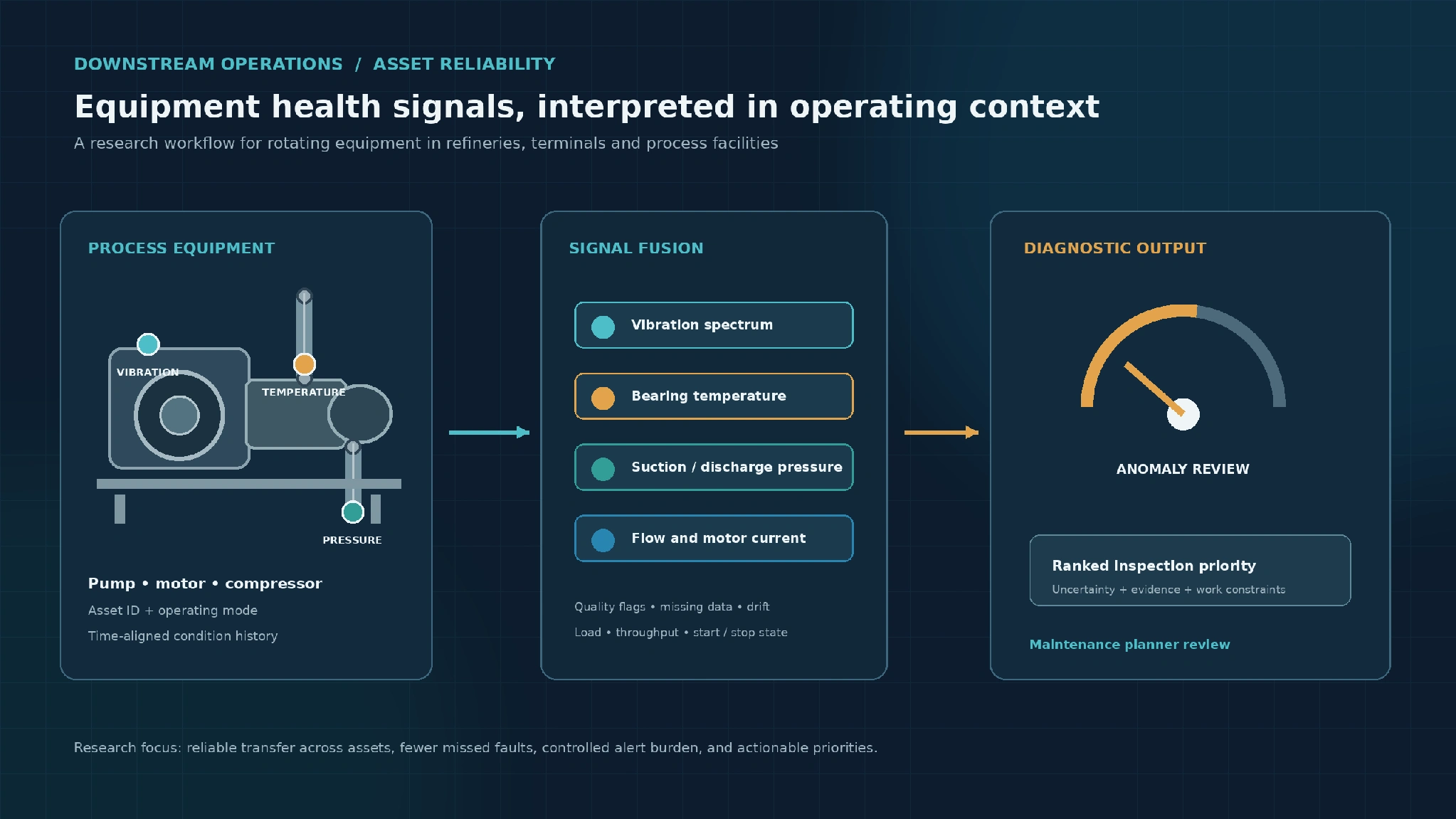
Rotating equipment can produce continuous vibration, temperature, pressure, flow, and electrical measurements, while confirmed failure events may be relatively rare. A model trained only on a small number of labeled failures can overfit to individual machines or operating conditions. Normal changes in throughput, fluid properties, speed, load, startup, shutdown, and recirculation can also resemble abnormal behavior.
The research question is whether diagnostic methods can learn useful representations from largely unlabeled operating histories, then adapt to a target asset using a smaller set of reviewed examples. Candidate methods include operating-mode-aware anomaly detection, self-supervised representation learning, transfer learning between comparable machines, and models that combine sensor features with maintenance history. A rules-based or established condition-monitoring baseline should remain part of the comparison.
The evaluation should distinguish anomaly detection from failure prediction. An anomaly score indicates that observations differ from a learned baseline; it does not establish a failure mode, failure probability, or remaining useful life. Remaining-life estimates require suitable historical failure and repair evidence, a defensible endpoint definition, and validation across the operating conditions in which the estimate will be used.
02
Multimodal inspection and defect detection
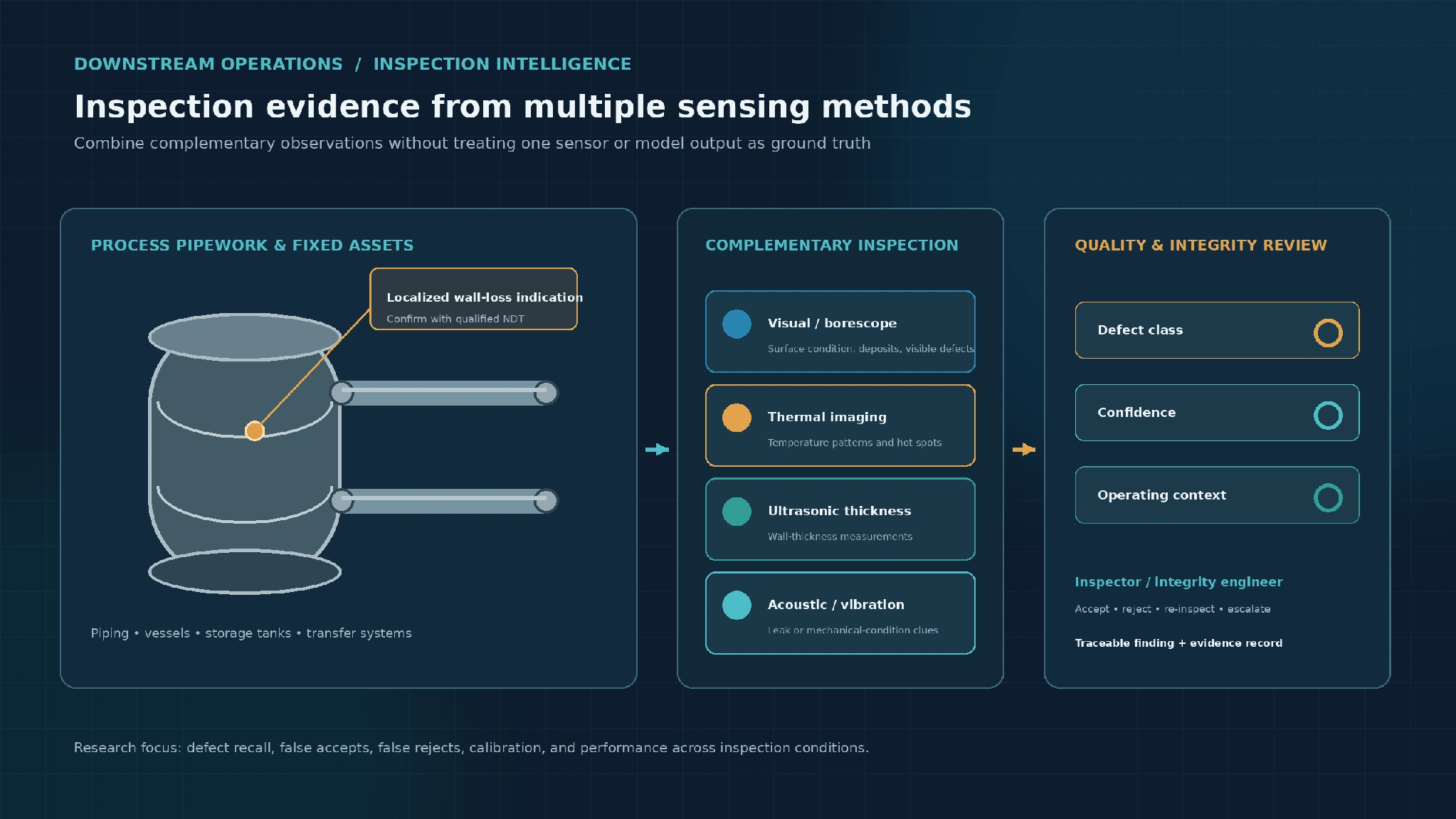
Downstream asset inspections may combine visual examination, borescope imagery, thermal imaging, ultrasonic thickness measurements, acoustic observations, and vibration data. Each method captures a different aspect of condition. A visual image may show surface corrosion or coating damage, while ultrasonic measurements provide thickness evidence at specific locations. Thermal patterns can identify temperature differences, but do not independently confirm the underlying cause.
The research question is whether complementary inspection modalities can improve defect detection and review quality compared with a single input or the existing inspection process. Candidate methods include image classification and segmentation, thermal anomaly analysis, signal-feature extraction, multimodal data fusion, and confidence-aware triage. The model should preserve the source modality, inspection location, asset identity, timestamp, equipment state, and measurement quality alongside each finding.
Evaluation should use independently labeled inspection cases and report performance by defect class and operating condition. False accepts and false rejects must be visible because an apparently strong overall score can conceal missed corrosion, cracking, erosion, leakage indications, or other consequential conditions. Synthetic imagery can support method development, but it must be identified as synthetic and cannot substitute for evaluation on representative field images and measurements.
03
Process quality prediction and defect-cause investigation
Product quality in refining and fuel handling can depend on feedstock characteristics, blend composition, process conditions, equipment performance, sampling practice, and laboratory measurement. Quality results may be sparse or delayed relative to the process data that preceded them. Records can also vary in sampling frequency, laboratory method, and product specification.
The research question is whether process histories and available quality measurements can help identify patterns associated with off-specification results and guide a disciplined investigation. Candidate methods include time-aligned feature analysis, supervised quality prediction where adequate labels exist, anomaly detection for process conditions, and interpretable models that rank contributing variables for engineer review.
A model that ranks correlated variables does not prove a causal defect mechanism. Any suspected cause must be checked against process knowledge, measurement quality, operating history, and controlled engineering investigation. Evaluation should include prediction error where appropriate, calibration, early-warning usefulness, false alarms, and the ability to transfer across products, units, or operating campaigns.
04
Risk-based maintenance and inspection priorities
Maintenance teams work within finite labor, spare-parts, access, outage-window, and permit constraints. A diagnostic signal is useful only if it helps a responsible team make a better decision. A low-confidence anomaly on a low-consequence asset should not automatically outrank a well-supported concern on equipment with greater operational consequences.
The research question is whether uncertainty-aware decision support can combine equipment condition, inspection findings, asset criticality, operating context, maintenance history, and resource availability to produce explainable inspection or maintenance priorities. Candidate methods include risk scoring, constrained optimization, ranking models, and decision-support rules that expose the evidence and assumptions behind each recommendation.
Evaluation should compare recommended priorities with a documented baseline planning method. Measures may include missed high-priority cases, false escalations, ranking stability, time to review, schedule feasibility, and maintenance planner usefulness. The system should show when information is insufficient and allow the responsible specialist to defer, override, or request additional inspection.