
Designing and Evaluating a Physical AI or AIoT Pilot
A useful pilot answers a defined operational question under representative conditions. In downstream operations, that may mean determining whether connected sensing can improve visibility into pump or compressor condition, whether AI-supported analysis can make inspection alerts more useful, or whether asset-event data can reduce reconciliation work. The pilot should establish the workflow, baseline, data requirements, success measures, and decision criteria before the system is configured.
Discuss a pilot evaluation for your facility →Artificial intelligence (AI) and the Artificial Intelligence of Things (AIoT) can connect field observations with operational information. Physical AI extends that path toward physical action, but a pilot does not need to control equipment to produce useful evidence.
Many evaluations should begin with observation, analysis, and human-reviewed recommendations. Any action that could affect process equipment requires a separately defined authority model, engineering review, and site-approved safeguards.
Start with a Specific Operational Question
Avoid defining a pilot as a general test of AI. Choose one operational problem, one asset or process boundary, and one decision the team needs to improve. Examples in downstream operations include:
Pump and compressor condition: determine whether vibration, temperature, pressure, or motor-current observations provide earlier or more actionable indications of an abnormal condition.
Static equipment and piping inspection: evaluate whether digital inspection records and selected sensing inputs help prioritize review of corrosion, temperature anomalies, or other documented conditions.
Tank farm and terminal operations: assess whether asset identity, level measurements, transfer events, and timestamps improve the completeness of inventory or custody records.
Refinery process monitoring: examine whether context-aware alerts help operators and process engineers distinguish meaningful deviations from normal changes during load variation, startup, or shutdown.
These are candidate evaluation scenarios, not statements that a particular Refinex product, connector, or deployment is already available. Select only a workflow supported by the facility’s data, equipment access, operating procedures, and approved project scope.
Define the Pilot Boundary
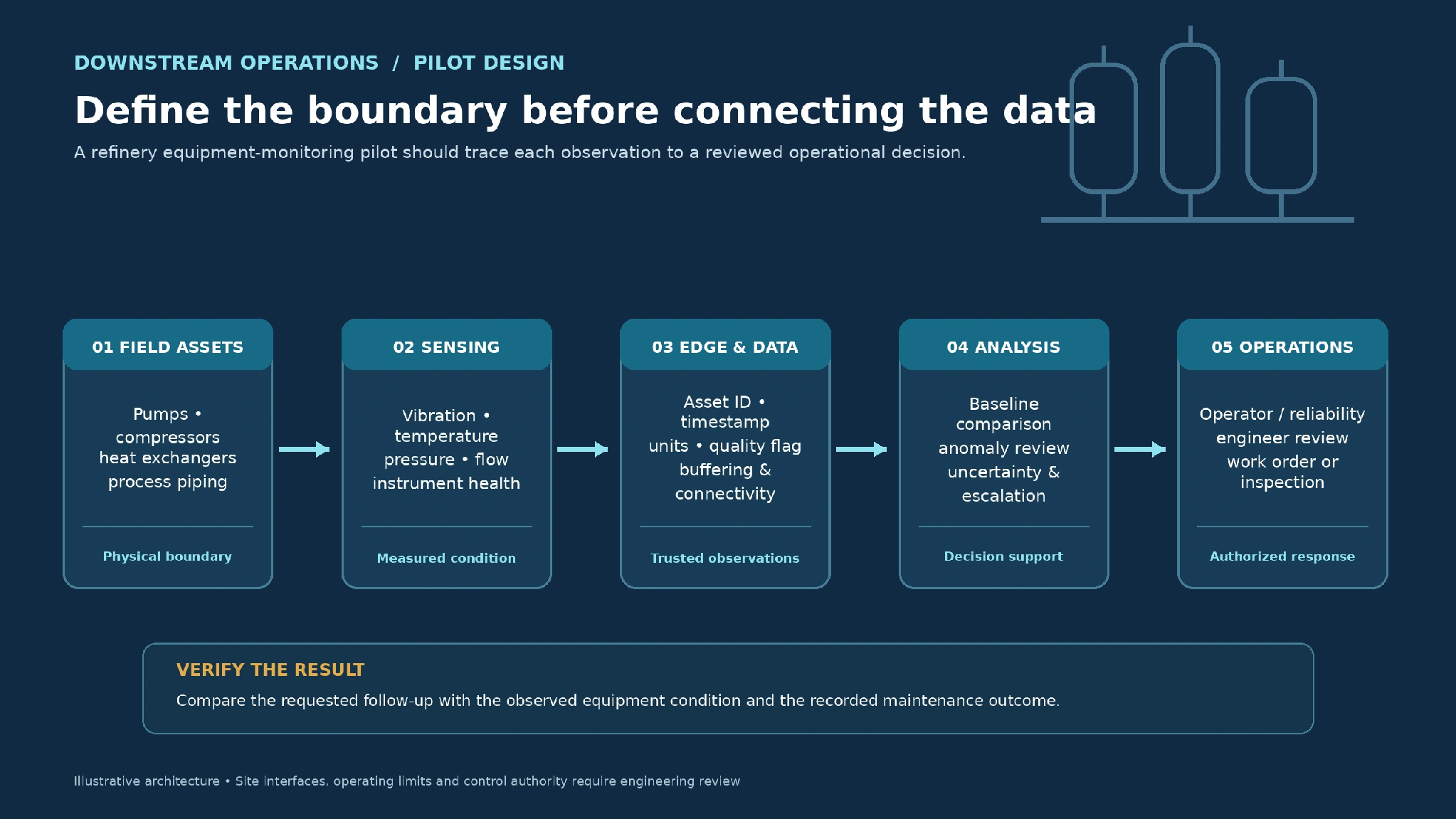
Write down what is included and excluded before collecting data. The boundary should be specific enough that operations, engineering, information technology (IT), and the pilot team agree on what will be evaluated.
| Boundary item | Questions to resolve |
|---|---|
| Assets and process | Which pumps, compressors, heat exchangers, tanks, piping circuits, loading systems, or process areas are in scope? What is explicitly out of scope? |
| Operating environment | Which unit, location, shifts, operating modes, throughput conditions, and access restrictions must be represented? |
| Users and decisions | Who reviews the information: console operators, field operators, reliability engineers, maintenance planners, inspectors, or process engineers? What decision can they make? |
| Data sources | Which historian, distributed control system (DCS), supervisory control and data acquisition (SCADA), computerized maintenance management system (CMMS), inspection records, or field sensors are approved for use? |
| Interfaces | How will asset identifiers, timestamps, units, event codes, and quality flags be exchanged? Which interfaces are tested and which remain proposed? |
| Authority and safety | Is the pilot read-only, advisory, human-approved, or permitted to issue a bounded command? Who authorizes each mode, and what independent protections remain in force? |
| Measures and period | What baseline period, test window, acceptance criteria, and review cadence are appropriate for the asset and operating cycle? |
Keep the first pilot narrow. A small, well-instrumented scope is easier to compare with the current workflow and easier to stop or revise if data quality, integration, or operational fit is inadequate.
Establish a Credible Baseline
The baseline describes how the task is performed today, before the candidate system influences the workflow.
Record the current instruments, inspection rounds, operator checks, alarm handling, maintenance notifications, manual reconciliation, and time required to resolve an exception. Note who performs each step and which records prove that it occurred.
Choose a baseline period that captures relevant operating variation. For rotating equipment, that may require representative load and operating modes. For tank transfers, it should cover the transfer events and reconciliation cycle being evaluated. For inspection workflows, include the types of equipment and findings that the proposed method is expected to encounter. Do not assume that a short, unusually stable period represents normal operations.
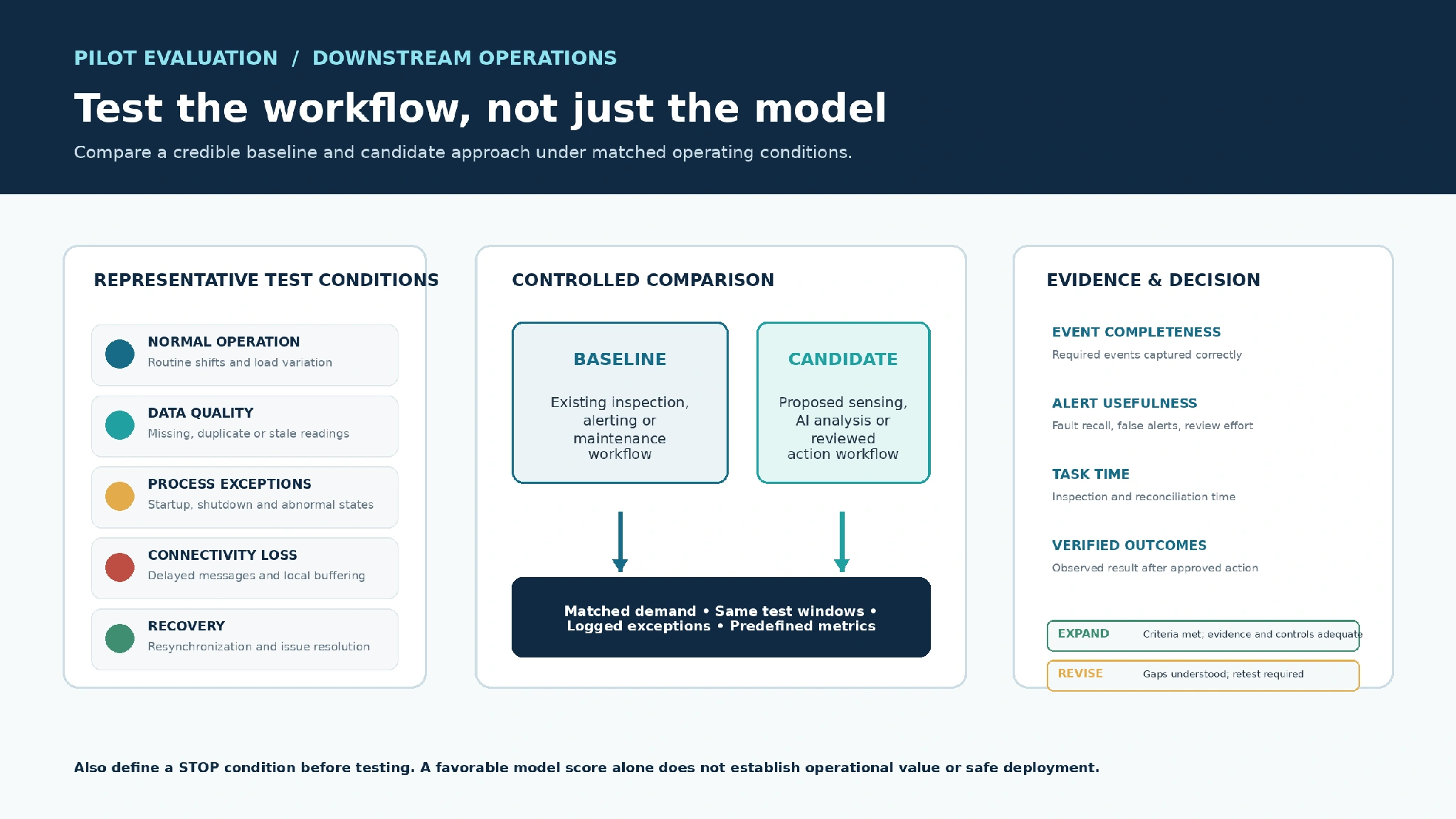
Where practical, compare baseline and candidate performance under matched operating conditions. Record changes in staffing, maintenance activity, sensor configuration, production demand, and operating procedures that could affect the comparison. If the workflow changes during the pilot, document the change rather than treating all observations as directly comparable.
Select Measures That Match the Use Case
Use a small set of measures tied to the operational question. Define each measure before the pilot begins, including its unit, denominator, time window, exclusions, and method of aggregation.
| Measure | Useful for | Definition or interpretation |
|---|---|---|
| Event completeness | Asset tracking, transfers, custody events | Correctly captured required events divided by required events established from an independent reference. |
| False-event or association rate | Identification and traceability | Incorrect, duplicate, or misassociated events relative to the defined event population. |
| Fault or anomaly recall | Condition monitoring and inspection | Detected fault or anomaly episodes divided by the independently established relevant episodes. |
| False-alert rate | Condition monitoring | False alerts per defined operating-hour basis, with repeated alerts grouped using a documented rule. |
| Detection or review delay | Monitoring and inspection | Elapsed time between the reference event and a valid detection or completed review. |
| Task and reconciliation time | Operations and maintenance workflows | Time required to complete a defined task, using the same start and end points in baseline and pilot. |
| Verified action rate | A pilot with an approved action path | Actions confirmed by observed outcomes divided by attempted eligible actions. A command acknowledgment alone is not proof of completion. |
Separate technical performance from operational benefit. A higher detection rate does not automatically mean downtime was avoided. An alert can reduce downtime only when the facility can review it, schedule a feasible intervention, obtain the necessary resources, and confirm the resulting condition. Report staff time released separately from cash savings.
Design Tests for Normal Operation and Exceptions
A pilot should test more than ideal data and routine operating conditions. Agree on test cases with operations, instrumentation, reliability, and IT teams. Include the cases relevant to the selected workflow:
Use historical records only when their provenance, quality, and permitted use are understood. If synthetic data or simulation is used before a site pilot, keep it separate from real operational evidence. A simulation can help test assumptions and refine the test plan, but it does not establish performance in a live facility.
- Normal operating variation across shifts, equipment loads, and expected process modes.
- Missing, duplicate, delayed, out-of-order, or stale sensor and event records.
- Sensor drift, outliers, instrument faults, incorrect asset association, and inconsistent units.
- Startup, shutdown, maintenance, inspection, and other transitions that change expected equipment behavior.
- Network interruption, gateway restart, server unavailability, buffering, and recovery or resynchronization.
- Abnormal conditions and known historical exceptions, including cases where the system should abstain or escalate rather than produce a confident recommendation.
- Human review delays, rejected recommendations, operator override, and unsuccessful follow-up where these are within the approved test scope.
Assign Responsibilities Before Installation
A pilot needs named owners for technical work and operational decisions. The exact assignments depend on the site, but the responsibility plan should cover:
Pilot sponsor: approves the business question, scope, resources, and final decision.
Operations owner: confirms the workflow, operating windows, user involvement, and permitted activities.
Reliability or maintenance owner: validates asset context, failure or inspection history, and maintenance follow-up.
Instrumentation and controls owner: reviews sensor placement, calibration status, signal quality, control-system boundaries, and field access.
IT and cybersecurity owner: approves data access, network paths, identity and permissions, retention, logging, and recovery arrangements.
Technical delivery owner: manages installation, configuration, data mapping, model or rules versioning, and issue tracking.
Evaluation owner: protects the baseline, applies the agreed metric definitions, records exceptions, and prepares the evidence report.
The facility’s established management-of-change, permit-to-work, process-safety, cybersecurity, and operating procedures remain applicable. A pilot must not bypass protective systems or change control logic simply to test an AI function. Any physical action requires explicit authorization, defined limits, a safe fallback, human oversight where required, and independent verification appropriate to the equipment and risk.
Move from Simulation to a Site Pilot
A simulation or bench test can reduce uncertainty before field work, but it should lead to a list of assumptions that need confirmation. Use the following handoff checklist when deciding whether the proposed approach is ready for a controlled site pilot.
- Assumptions to verify: Asset behavior, operating modes, event rates, sensor placement, signal ranges, connectivity, and response times.
- Real measurements needed: Relevant instrument readings, asset identifiers, timestamps, operating modes, maintenance and inspection records, and independently confirmed events.
- Baseline period: A representative window covering the operating conditions and task cycle being evaluated.
- Acceptance criteria: Predefined technical and operational thresholds, measurement methods, exclusions, and evidence required for each criterion.
- Operating conditions: Normal operation, relevant transitions, known exceptions, degraded data, network interruption, and recovery.
- Responsibilities: Named owners for installation, data review, operational oversight, cybersecurity, issue handling, and approval.
- Stop or revise criteria: Unsafe or unauthorized behavior, unreliable data, unacceptable false alerts, integration failure, excessive operator burden, or inability to verify outcomes.
A successful simulation is a reason to test an approach, not a substitute for a site pilot. Before field deployment, review the test plan with the facility’s responsible engineering and operations authorities.
Evaluate the Evidence and Make a Decision
At the end of the test, compare results with the acceptance criteria agreed before configuration. Report what was tested, what was not tested, the operating conditions represented, data exclusions, system versions, unresolved issues, and any changes made during the evaluation. Include unfavorable results and cases in which the candidate approach performed no better than the baseline.
- Did the candidate approach meet each technical and operational acceptance criterion?
- Were the results consistent across the operating conditions and exception cases that matter?
- Could users understand, review, and act on the outputs without creating unacceptable workload?
- Were integration, cybersecurity, data quality, authority, and recovery requirements met for the tested scope?
- What remains unverified before a wider deployment or any change in operating authority?
Choose one of three outcomes
When the agreed criteria are met and the evidence, operational fit, and controls support a larger, still-bounded phase.
When the approach appears useful but data, integration, model behavior, workflow, or user adoption needs further work.
When the problem is not material, evidence is inadequate, risks cannot be controlled, or the candidate does not provide sufficient value compared with the baseline.
Understand What the Evidence Proves
Use precise evidence labels in pilot reports and related website material. An illustrative scenario has not been executed. An executed simulation uses synthetic data and modeled assumptions. A controlled bench or hardware test demonstrates behavior in a defined test setup. A customer pilot records results from a stated facility scope and period. An operational customer result requires evidence from the actual operating scope being described. Keep implementation status separate: proposed, implemented for demonstration, or deployed within a clearly stated scope.
An illustrative scenario has not been executed.
An executed simulation uses synthetic data and modeled assumptions.
A controlled bench or hardware test demonstrates behavior in a defined test setup.
A customer pilot records results from a stated facility scope and period.
An operational customer result requires evidence from the actual operating scope being described.
Do not present simulated results as customer results, imply that a proposed interface is already supported, or describe a pilot as proof of universal compatibility. State the equipment, data, operating conditions, and limitations to which the evidence applies.